Summary –
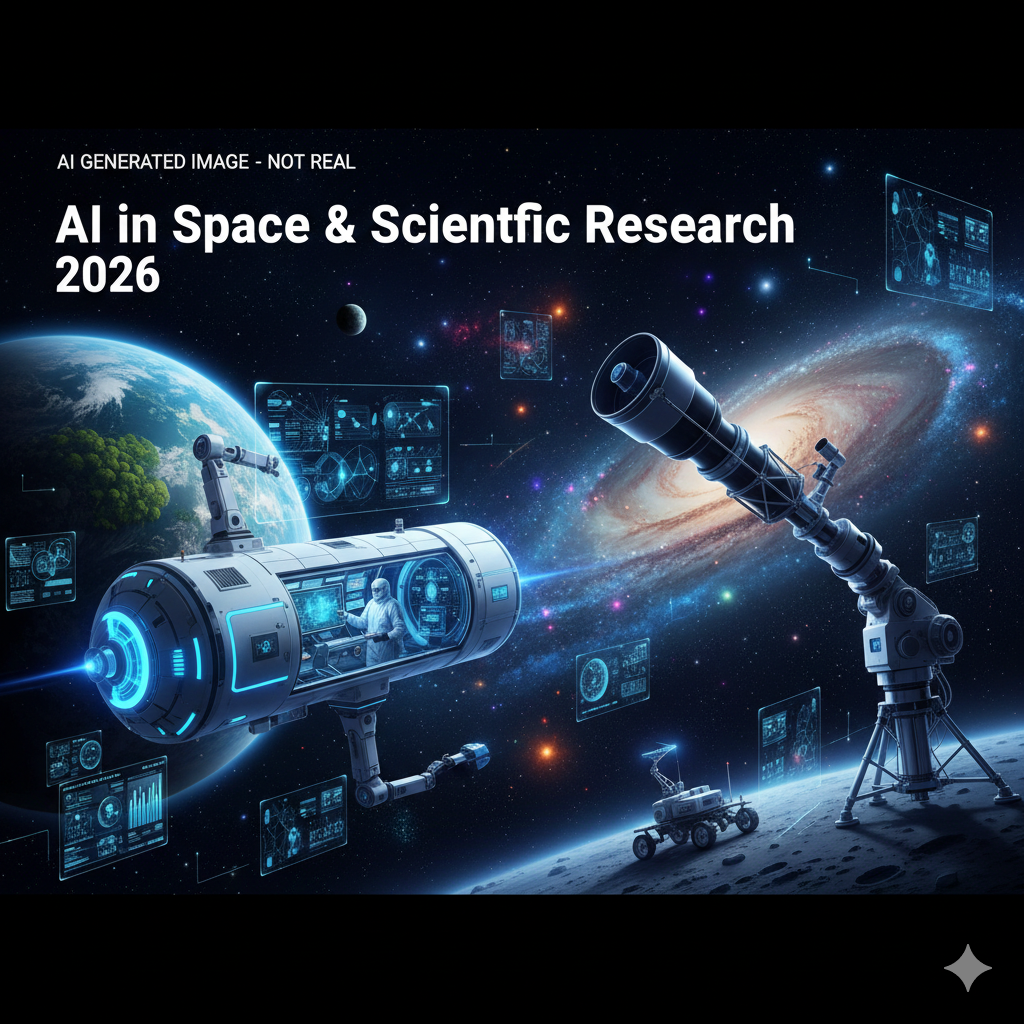
Artificial Intelligence is playing a growing role in space exploration and scientific research in 2026. From satellite image analysis and climate modeling to space mission simulations and astronomical data processing, AI is accelerating discoveries and improving operational efficiency in research institutions worldwide.
Top 10 Key Points
- AI enhances satellite image interpretation
- Climate modeling powered by AI improves accuracy
- Space mission simulations become more precise
- AI accelerates astronomical data analysis
- Predictive maintenance supports spacecraft systems
- AI aids in planetary exploration robotics
- Research institutions deploy AI supercomputing
- AI assists in drug and material research
- Automated data classification improves efficiency
- International collaboration expands AI research
In 2026, Artificial Intelligence has become a critical tool in scientific advancement. Satellite imagery analysis powered by AI helps researchers monitor deforestation, urban growth, and climate change impacts with enhanced precision.
AI-based climate models process vast datasets, improving predictive weather and environmental forecasting.
Space agencies are using AI simulations to optimize mission planning, fuel efficiency, and spacecraft trajectory accuracy.
Astronomical research benefits significantly from AI-driven data processing. Massive datasets collected from telescopes are analyzed using machine learning models to identify celestial patterns and anomalies.
Predictive maintenance powered by AI monitors spacecraft systems, identifying potential mechanical failures before they occur.
Robotic exploration missions increasingly rely on AI decision-making algorithms to navigate unpredictable planetary environments.
Supercomputing systems integrated with AI accelerate scientific experiments in fields such as materials science and pharmaceutical research.
Automated data classification reduces research time, allowing scientists to focus on hypothesis testing rather than manual sorting.
AI in space and research 2026 is accelerating global scientific discovery and innovation.
📢 Disclaimer
This article is written for informational purposes only. The trends and developments discussed are based on publicly accessible scientific publications, research institution updates, technology news sources, and industry reports available in 2026. It does not represent official statements from any space agency, research organization, or government body. Readers should refer to official scientific publications for validated research findings.